
The New Solo 401(k) Catch-Up Roth Rule: What It Means for Us Solo Operators
The 'don't blame me' blurb: I am not a financial advisor, portfolio manager, or accountant. This is not tax or investment advice; it's information to get you going. Please consult your trusty professional and do your due diligence. Carry on!
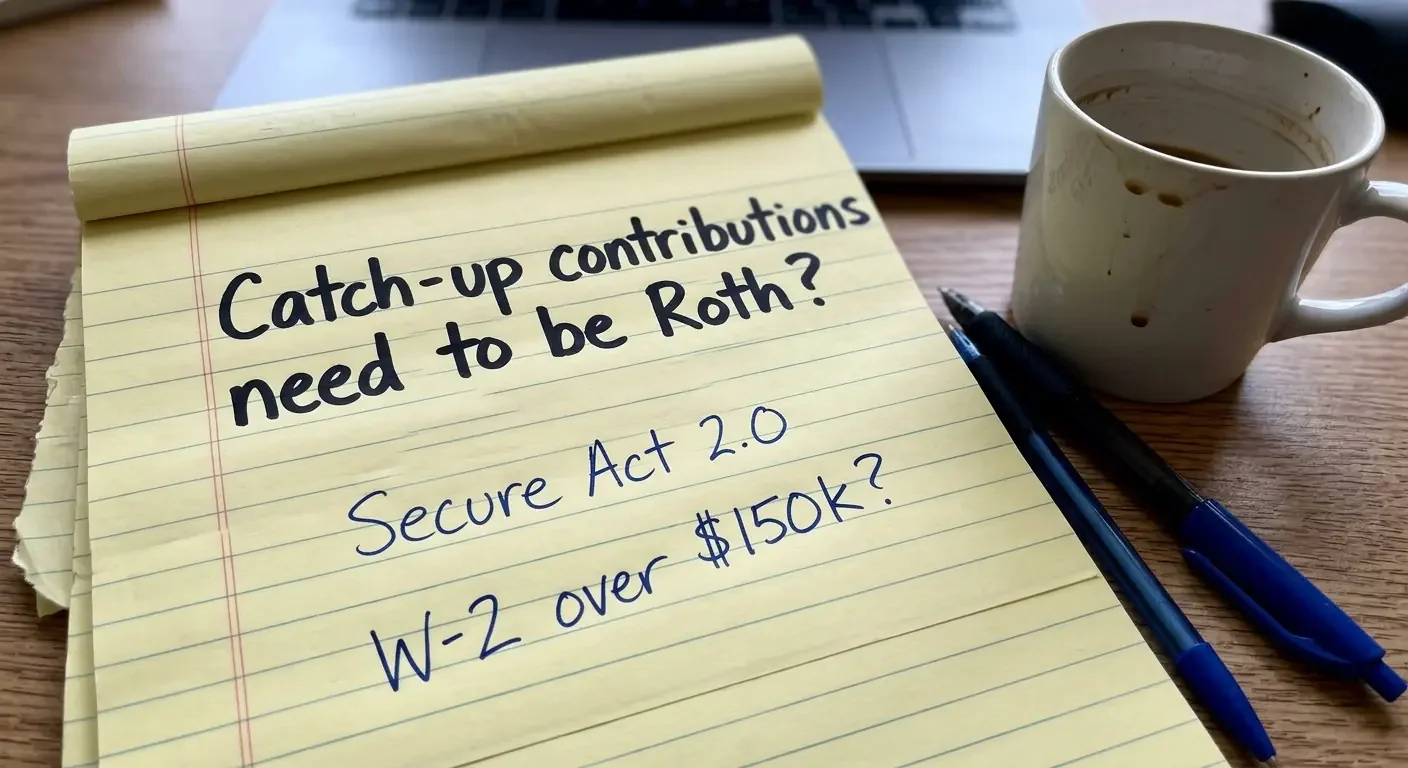
Yes, yet another rule to be aware of.
TL;DR
If you’re an S-Corp and pay yourself $150,000+ in W-2 wages, and are age 50+, this may affect you.
If your W-2 was over $150k in 2025, your Solo 401(k) employee catch-up contributions must now go into a Roth Solo 401(k).
If you're under the $150,000 limit, or if you’re a Sole Proprietor or LLC and not an S-Corp, keep on hustling; you dodged the bullet.
We are not talking about the Backdoor Roth IRA here. That is a completely separate account with its own contribution limits and rules. Yes, you can have both accounts at the same time.
I’m a little late writing about this one; luckily, it probably won’t affect many people.
Starting January 1, 2026, a new SECURE 2.0 provision kicks in that forces some retirement savers age 50+ to make their catch-up contributions into a Roth Solo 401(k) in after-tax dollars instead of pre-tax. No opt-out.
Here's the part that should make most of you exhale: this rule probably doesn't apply to you.
Who Actually Gets Hit
The rule only looks at FICA wages — the number in Box 3 of a W-2. If you don't have a W-2, you don't have FICA wages. And if you don't have FICA wages, the rule has nothing to grab onto.
| Your setup | Subject to the rule? |
|---|---|
| Sole proprietor / Schedule C | No — self-employment income isn't FICA wages |
| Single-member LLC (disregarded) | No — same reason |
| Partner receiving a K-1 | No |
| S-corp paying yourself a W-2 salary | Maybe — depends on the number |
That last row is where the rubber hits the road. Like me, plenty of freelancers form an S-corp specifically to save on self-employment tax — which means you do have a W-2, and this rule can absolutely find you.
The Actual Number
If you're in that S-corp bucket, here's what matters:
Threshold: $150,000 in FICA wages (Box 3, W-2)
Which year counts: the prior calendar year — 2025 wages determine your 2026 requirement
What's affected: only the catch-up portion, not your regular employee or employer contributions.
So if your 2025 W-2 salary was under $150,000, you're fine — full pretax-or-Roth choice on your catch-up money in 2026. If it was over, the catch-up piece has to be Roth. Period.
What is the "Catch-Up" part of the Solo 401(k)?
For 2026, once you turn 50, you get to stack extra money on top of the regular $24,500 employee deferral limit:
Ages 50–59: additional $8,000
Ages 60–63: additional $11,250 (the "super" catch-up SECURE 2.0 created)
If you clear the $150,000 threshold, that extra chunk — $8,000 or $11,250 — has to land in a Roth account. Everything below it is still your call.
With most providers now, you can have a pre-tax Solo 401(k) AND a Roth Solo 401(k) sitting side by side on the same plan. Your contribution limits are shared between the two accounts; you don’t get double. Be aware that the two Solo 401(k) accounts must be with the same provider, on the same plan.
For example, it's illegal to have a pre-tax Solo 401(k) with Schwab and a Solo 401(k) Roth with Fidelity. The IRS will disallow contributions and make your life hell.
Need to brush up on how the Solo 401(k) works? Read the Solo 401(k) guide here or ask the Digital Chris in the bottom right-hand corner some questions.
If you’re a high-income earner and want to max out your Solo 401(k) to the total contribution limit, the Mega Backdoor Roth article is for you.
Your Move
Pull last year's W-2 (if you're an S-corp) and check Box 3. If it was over $150k:
Call your Solo 401(k) provider and ask point-blank: Is it possible to open a Roth Solo 401(k) that sits next to your existing pre-tax one on the same plan? I’m with Schwab, and they have pre-tax and Roth.
Don't wait until December to find this out.
This is one of those rules that sounds intimidating in the headlines and turns out to be a non-event for most self-employed people. But "most" isn't "all" — and if you're the S-corp freelancer with a fat salary line, this is the year to actually check the number instead of assuming.






















If you're 50+, self-employed, and someone just told you your catch-up contributions have to be Roth now, don't panic yet. Most freelancers are completely exempt — and here's why.